Five Business Agents Worth Building
Five useful workflows and the different ways to put them to work

At 8 a.m., the queues are already forming. A signed customer agreement is waiting for an account to be opened. A customer needs a return. An invoice needs matching, the front desk is answering calls and a denied claim is approaching its deadline. Much of the day will be spent moving information to the place where someone can act on it.
Agents can take on some of that coordination. Give one a defined piece of work, the records it needs and clear limits on what it can change. It can carry routine steps through to completion and bring a person in when something needs judgment.
The aim is better use of the team’s time: quicker answers for customers, less chasing and rekeying for staff, and a clearer view of where the process is stuck. Whether the agent delivers those gains should be measured against the way the work is done today.
Five types of agent stand out because their work has recognizable inputs, systems of record and outcomes. Each can begin with a narrow workflow and earn more responsibility as its performance becomes clear. None needs to start with a department-wide mandate.
Harnesses and custom applications
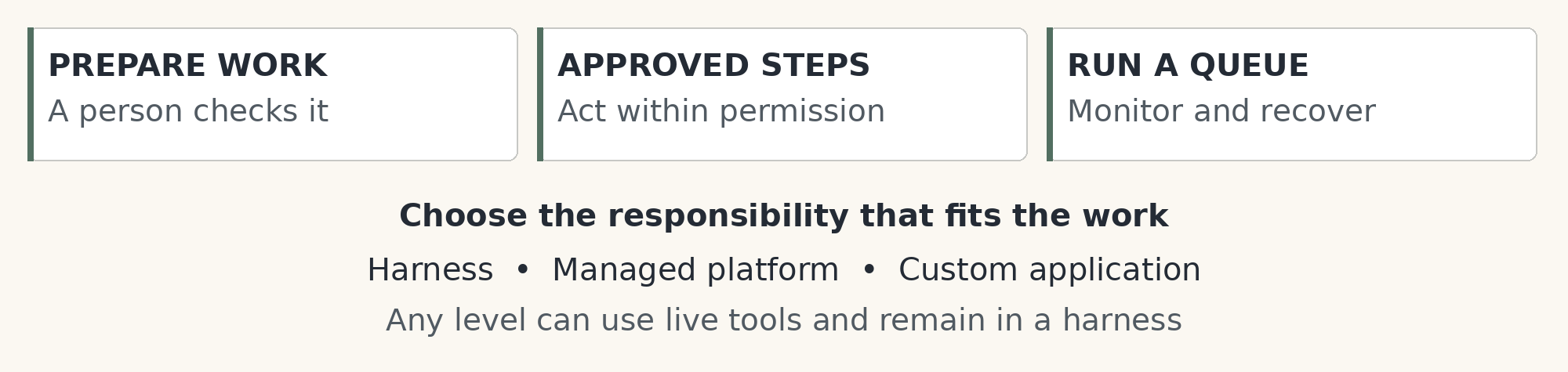
A useful agent does not always require a new application. A person can run a repeatable workflow in an existing harness: the environment around a model that supplies instructions, files, tools, execution and approvals. For many internal tasks, that can be the permanent home.
The model interprets the request; the harness organizes the work; the connected business systems hold the records.
Claude Code and Codex are examples of agent environments that can work with tools and code; they can help build an integration and, when appropriately configured, run a workflow. A reusable skill can package the procedure and supporting scripts.
A connector or Model Context Protocol server can expose a narrow action such as checking an order or preparing a bill. The skill describes the work; the tool’s authorization controls determine what is allowed. Claude Code architecture · Codex as a platform
Grok Bot offers a different packaged environment: xAI documents a persistent cloud computer, connected apps, and reusable skills and routines. Its Bots share an account’s computer and sessions, so separate bot names should not be treated as separate security boundaries.
A custom Grok-powered application built through the xAI API is a different option, with its own hosting, tools and controls. Grok Bot overview · Grok Bot security
Choose the level of responsibility
There are three useful levels of responsibility. Prepare the work: the agent assembles records and drafts a result for a person to check. Complete approved steps: it performs defined actions within its permissions. Run a defined queue: it handles incoming work with monitoring, recovery and assigned exception owners. Any level can use live tools. Any can remain in a harness.
A connected harness may be enough for a small finance team’s daily review. A shared service becomes worth considering when many users need consistent access, work must continue unattended, or response times and audit requirements exceed what the current environment can provide.
It might use the same harness on managed infrastructure, an existing business platform or a custom application. Add infrastructure for a specific operational need. Anthropic’s guidance similarly recommends starting with the simplest solution that fits. Anthropic on effective agents
Try one bounded task
To start, collect the procedure, approved policies and a few test cases in the chosen environment. Then give it a bounded job: “Review these onboarding files against this checklist. List missing or conflicting fields with the source for each. Prepare the customer record and welcome message for review. Do not send messages or change live records.”
Review the result, correct the procedure and save it as a reusable skill where supported. Add only the tools it needs, with secrets held in the environment’s credential facility. Every run should finish with a record of what changed, where it changed and what remains unresolved.
Administrative operations
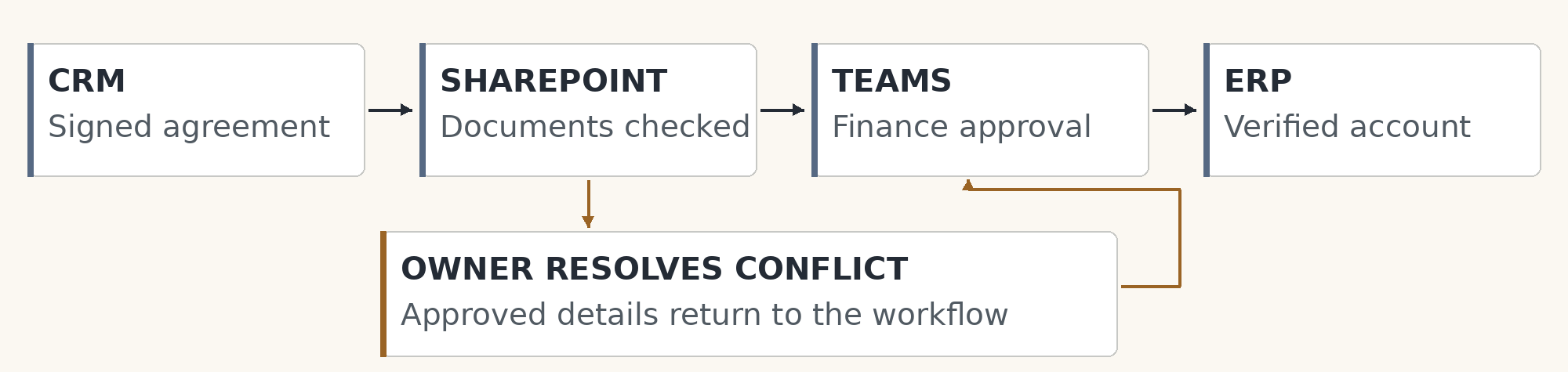
Customer onboarding is a useful way to return time to several teams at once. A request may pass through sales, finance, legal and operations before the account is ready. An agent can carry it across those boundaries, reducing the chasing while preserving each team’s authority.
How it works
Consider customer onboarding. A signed agreement in the CRM starts the process. The agent checks an approved checklist in SharePoint, gathers the required documents, compares the billing details with the customer record and prepares an account in the ERP.
It sends the relevant approval request in Teams, tracks the response and uses Outlook to send the agreed welcome message after the account is ready.
One record.
Four clear states.
Keep one onboarding record with a request ID, an owner and explicit states: awaiting documents, awaiting finance approval, ready to create and complete. A saved case file may suffice for an assisted run. For work that waits across sessions or enters a shared queue, persist state so it can resume reliably.
- 01Awaiting documentsGather the required information.
- 02Awaiting finance approvalKeep the decision with its owner.
- 03Ready to createUse the approved record version.
- 04CompleteVerify the account and save the outcome.
Connect Outlook, Teams and SharePoint through the appropriate Microsoft Graph permissions, with separate adapters for the CRM and ERP. Microsoft distinguishes delegated access, which acts on behalf of a signed-in user, from application access, which runs without one. Choose permissions deliberately and restrict the records and actions each workflow can reach. Microsoft Graph permissions
Keep decisions with their owners
The first version should prepare records and surface discrepancies for review. Once the team trusts it, permit selected writes, such as creating a draft customer record or updating the onboarding status. Keep pricing changes, legal terms and sensitive master-data changes with their designated owners. An approval should apply to the exact version of the record that will be written.
If the contract and CRM disagree about the billing entity, the agent should show both values and ask the responsible person to resolve them. Its job is to make the disagreement easy to fix, not to choose whichever value looks more plausible.
Customer service
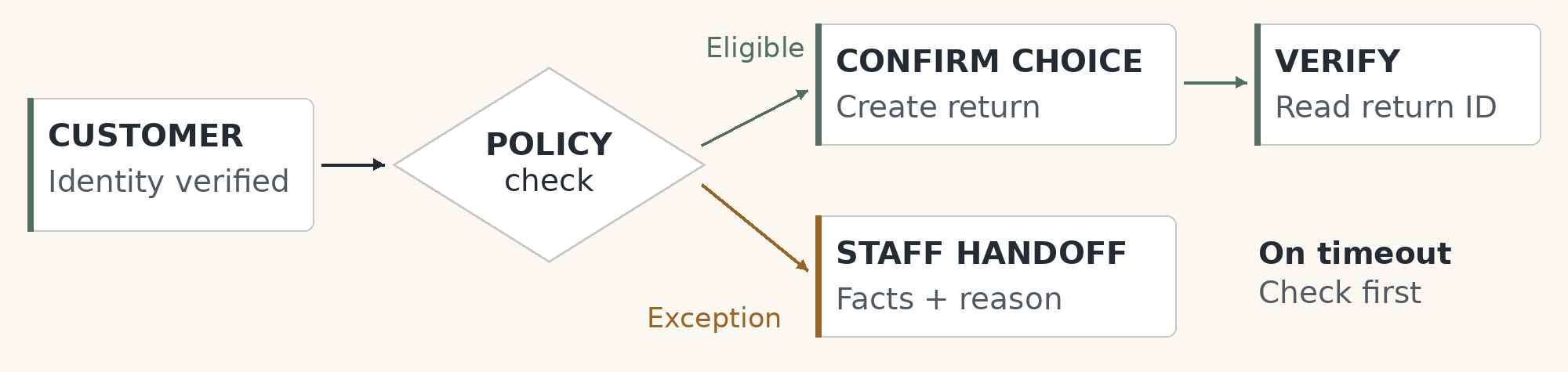
A customer can tell when a service request is finished: the replacement is ordered, the delivery address is corrected or the billing problem is resolved. A well-written answer helps, but it rarely substitutes for the underlying action.
How it works
Take a straightforward return. The agent identifies the request, authenticates the customer through the existing account flow and retrieves the order. It checks the relevant policy, explains the available options and asks the customer to confirm their choice.
It then calls the approved returns service, verifies that the return was created and records the outcome in the support system.
Use the help desk or CRM as the case record, the order system for transaction facts and a maintained knowledge base for policies. Keep eligibility checks and monetary limits in executable rules. The model can interpret the customer’s language and explain the decision; it should not invent an exception to a return policy.
Test the awkward cases
Build the first release around one request type. Test it against representative past cases, including awkward ones: an order belonging to someone else, an expired return window, a partial shipment and a customer who changes their mind halfway through. Begin with suggested actions for staff, then enable automatic completion only for cases that meet the agreed conditions.
Pass the case.
Keep the context.
Make the handoff useful. A person should receive the customer’s goal, the facts already checked, the action attempted and the reason the agent stopped. Suspected fraud, disputed charges, unusual concessions and unresolved identity checks need a clear destination rather than another round of questions.
- Customer goal
- The outcome the customer needs.
- Facts checked
- What the agent has already verified.
- Action attempted
- What it tried and what happened.
- Reason for stopping
- The exception a person needs to resolve.
A timed-out transaction is a particularly important test. Before trying again, check whether the first request succeeded. Use a unique operation key where the API supports one so a retry cannot create a second return or duplicate refund.
Accounting operations

An accounting agent can reduce the time finance spends preparing routine entries and investigating avoidable mismatches. An invoice with a missing purchase order still needs attention, but a clean invoice should arrive ready for review rather than another round of data entry.
How it works
Accounts payable is a practical starting point. The agent receives an invoice, extracts the supplier, invoice number, line items and amounts, and checks them against the approved supplier record. It looks for duplicates, matches the invoice to the purchase order and receipt, and prepares a bill in the accounting system when the checks pass.
Use document extraction for invoices and ordinary code for arithmetic, tax calculations and matching tolerances. Keep the original beside the extracted fields so a reviewer can trace and correct a value without restarting the process.
Start with one part of the books
Build the integration around the ERP or accounting platform’s native records and approval flow. Start with one legal entity, one invoice channel and an agreed class of invoices. In a test environment, prove that the agent can handle credits, duplicate invoice numbers, partial receipts and a closed accounting period before it touches live books.
Three jobs.
Separate permissions.
Separate preparation, approval and payment. An invoice-processing agent should not be able to create a supplier, change that supplier’s bank details and release a payment. Requests for bank-detail changes belong in a separately verified process, even when they arrive on a convincing invoice or email.
- PrepareExtract, match and draft the bill.
- ApproveReview the evidence and resolve exceptions.
- PayRelease payment through the authorized process.
The exception screen matters as much as the matching logic. Instead of saying “review required,” show the invoice line, the purchase-order line, the difference and the person who can resolve it. Keep the reason for each correction so recurring supplier problems become visible.
Receptionist agent
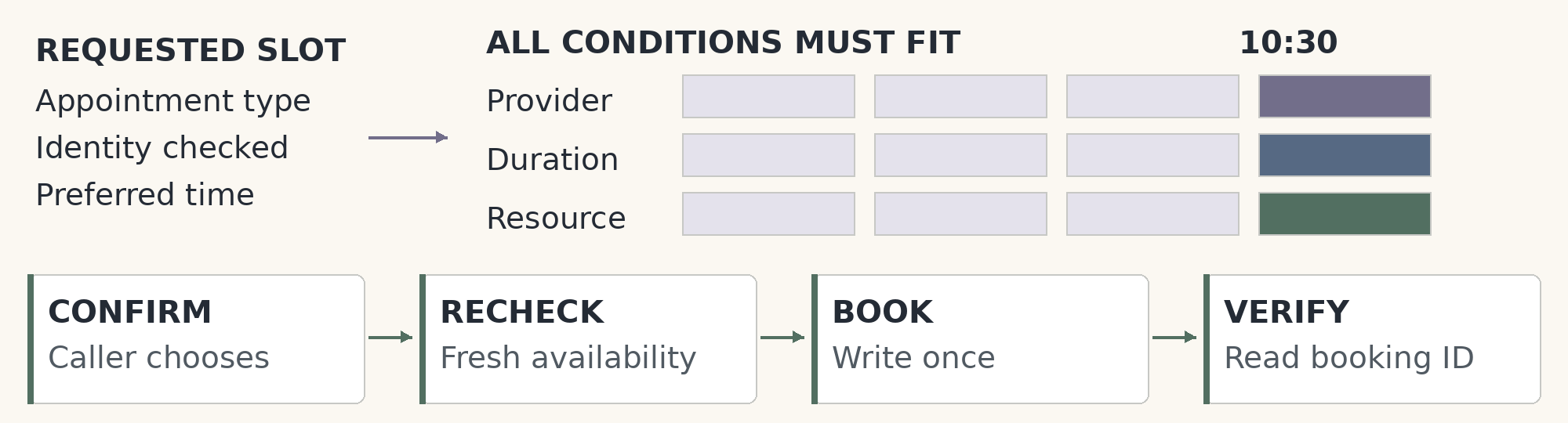
A receptionist agent can give a small business more capacity at the hours when calls are hardest to cover. Its first useful assignment is often simple: answer routine questions, find a suitable appointment and leave the staff with a reliable record.
How it works
For a dental office, that might mean asking whether the caller is an existing patient, identifying the requested appointment type and checking the practice’s scheduling rules. The agent offers available slots, repeats the selected time and books it only after confirmation. It sends a confirmation through the approved channel and adds a concise note for the front desk.
Connect telephony, speech recognition and synthesis, the scheduling system and approved office information. Pay close attention to calendar rules. Appointment length, provider availability, equipment and new-patient requirements determine which slots can be offered.
Begin with one appointment type
Start with after-hours inquiries or overflow calls for one appointment type. Keep the scope small enough that staff can review every result during the pilot. Add rescheduling and cancellations only after the booking flow handles interruptions, misspelled names, misunderstood dates and callers who decline to provide required information.
Two callers.
One available slot.
Check availability again immediately before booking and verify the appointment afterward. Two callers may have been offered the same slot. If a booking fails, the agent needs to say so and offer a real next step rather than leave the caller believing it is confirmed.
Book, then verifyNo longer available
Offer a real next step
Make it easy to reach a person. In a clinical setting, symptom reports need an approved escalation path; the receptionist should not diagnose or decide that care can safely wait.
Review applicable requirements for call recording, consent, privacy and disclosure before launch. A law office also needs rules for confidential intake and avoiding promises about representation.
Healthcare revenue cycle
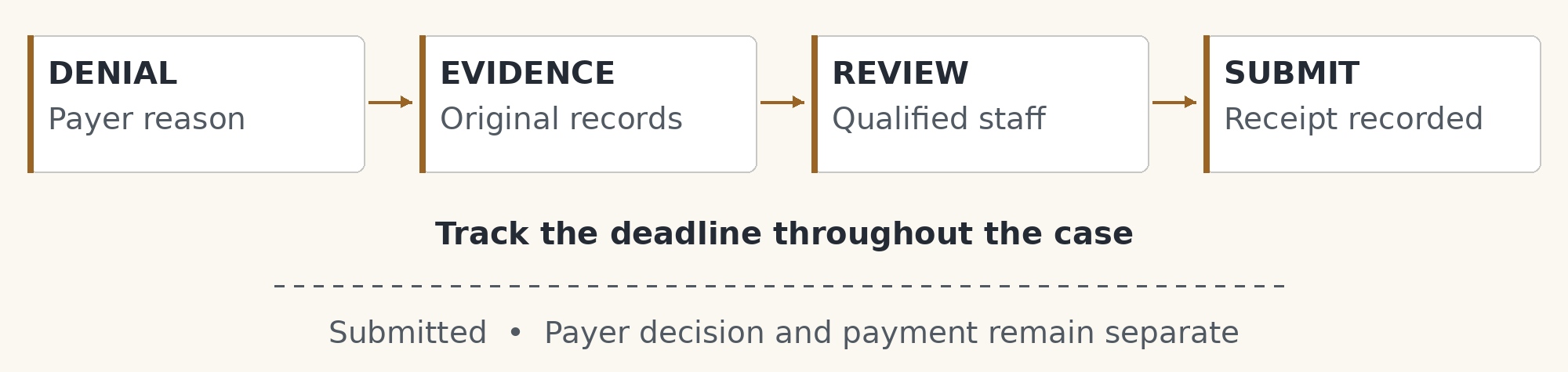
A revenue-cycle agent can turn a deadline-bound backlog into cases that are ready to act on. Its useful work is finding missing information, assembling the evidence and keeping the next action visible to the team.
How it works
Begin with one denial category. The agent reads the payer’s reason, retrieves the claim and relevant records, checks the current instructions and prepares a correction or appeal for review.
The same case structure can support coverage verification, prior-authorization preparation and claims follow-up. Expand one step at a time, with the required records, qualified review and a recorded response. Coverage verification, authorization and payment each need their own definition of completion.
Connect the electronic health record, billing system, clearinghouse and payer interfaces through supported tools. Eligibility, claims, claim status and remittance have established administrative transaction standards. Map those exchanges to the actual workflow rather than assuming every payer provides the same interface. CMS standards
Keep clinical decisions with qualified staff
Keep clinical documentation authoritative. The agent can identify a missing attachment or summarize the reason a payer gave. It should not invent a diagnosis, alter clinical facts, make a medical-necessity determination or change coding merely to obtain payment. Assign those decisions to the appropriate clinical, coding or billing professional.
Before using protected health information, review the entire data path, access controls and retention. HHS requires an appropriate business associate agreement when a cloud provider processes or stores electronic protected health information on a covered entity’s behalf, even if it cannot view encrypted data. The specific deployment also needs security and privacy review. HHS cloud guidance
Assign named staff to the exceptions. Missing records, ambiguous guidance and approaching filing limits need prompt attention. Record the deadline and supporting evidence throughout the case.
An appeal moves through different finish lines.
- 01 / SubmissionDid the payer
receive it?Record the submission receipt. - 02 / DecisionWhat did the payer
decide?Record the response. - 03 / PaymentWas payment
received?Track the financial outcome separately.
The foundation each agent needs
These agents can share infrastructure: authenticated intake, a saved workflow record, approved information, a small set of tools and an exception queue. The language model handles interpretation and drafting. Ordinary software should enforce permissions, validate fields and control which actions can run.
Keep sources and permissions clear
Retrieve policies with their owner, effective date and access restrictions. Treat emails, documents and webpages as evidence, never as authority to grant new permissions. A malicious instruction inside an invoice must not be able to change who gets paid.
Put consequential actions behind a policy check outside the prompt. The check should evaluate the user or service identity, the requested action, the relevant records and any required approval.
Keep credentials outside the model’s context. Give each connector only the access its workflow needs. OWASP’s guidance likewise places authorization checks in the execution layer rather than relying on the model to enforce them. OWASP guidance
Make failures recoverable
Every action also needs a recoverable path. Save progress before and after a write, record the system’s response and read back the result when appropriate. If the outcome is uncertain, investigate before retrying. If a change cannot be safely reversed, require the appropriate review before it happens.
Leave a trail
someone can follow.
Log enough to reconstruct what the agent did and why, without needlessly copying sensitive content. Keep the policy version, source references, tool calls, approvals and final outcome. A named person must own the exception queue and have a way to stop the workflow.
- 01Policy version
- 02Source references
- 03Approvals
- 04Tool calls and responses
- 05Final outcome
A practical way to start
Establish the baseline
Choose a recurring piece of work with a clear finish line and a willing process owner. Document the current volume, waiting time, error rate and handling effort before building anything. Those measurements give the pilot a fair baseline.
Map the actual process
Map the actual process, including the ways it fails. Decide which system owns each fact, which actions the agent may take and which decisions remain with staff. Build a small set of tools around that map rather than giving the agent broad access and hoping it discovers the process.
Test before live changes
Run representative cases in a test environment, then compare the agent’s recommendations with real staff decisions without letting it make live changes. Test expired permissions, stale policies, duplicate requests, conflicting records and unavailable systems. Give operational staff enough visibility to challenge the result.
Expand one action at a time
Move to supervised execution, then expand autonomy by action. A team might approve automatic status updates before it approves automatic bookings or financial postings. Define acceptable performance and stop conditions in advance, and retest when the model, policy or integration changes.
Judge the investment by the work that gets finished correctly and the capacity it returns to the team. Include integration, software, oversight and correction costs. Hours saved only become business value when they improve service, reduce backlog, increase throughput or allow people to spend more time on work that needs their attention.
The best first agent has a modest scope and a useful result. Once the team can trust that result, it has a sound basis for deciding what to build next.