The First Agentic Farm: A Weather Station, a Pump, and an Agronomist in the Same Room
FIELD NOTE · AI SYSTEMS / AGTECH
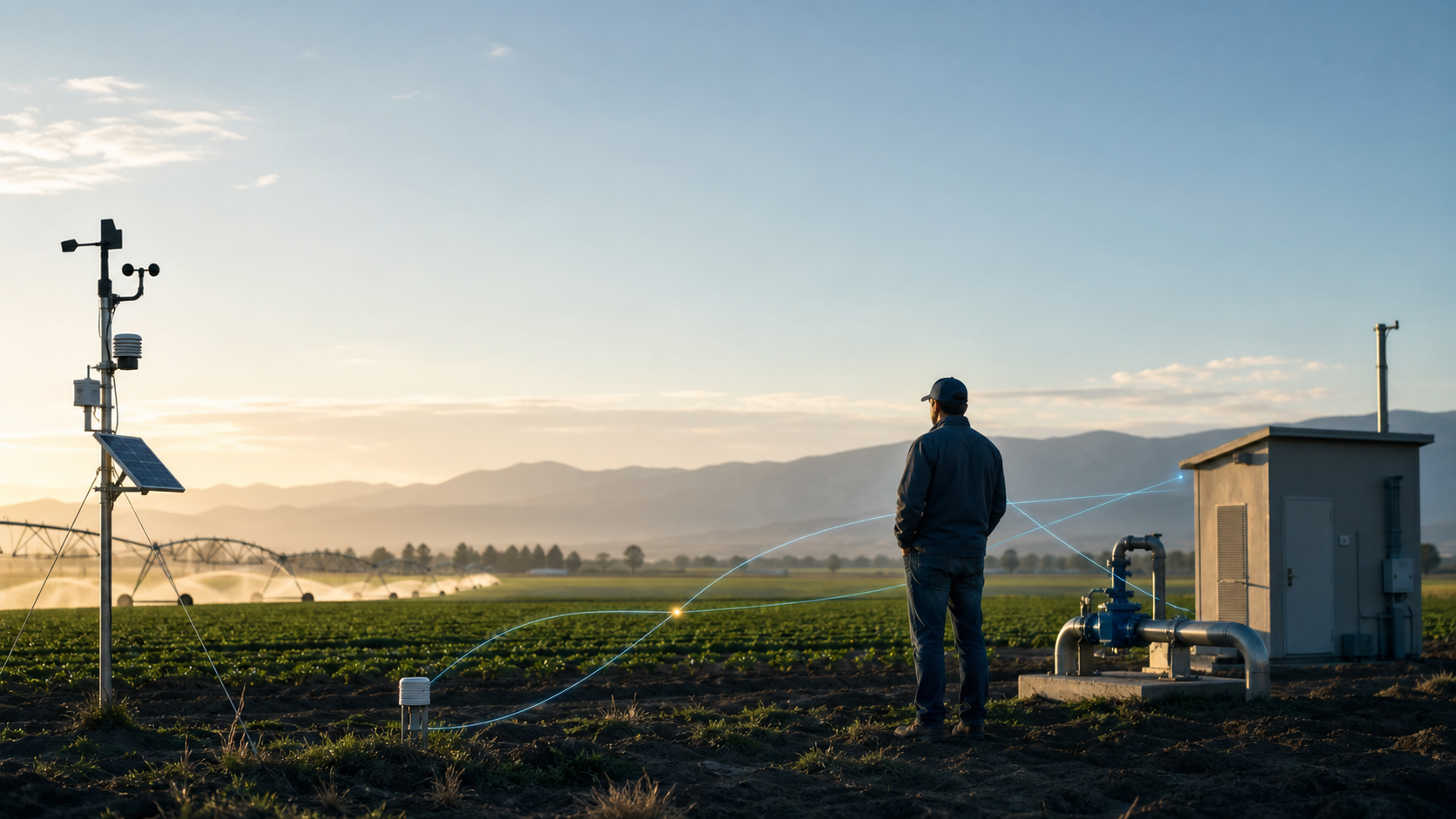
At 5:40 a.m., the irrigation agent wanted to turn the pump on. The soil sensor said the north field was dry. The weather service said rain was 70% likely. The water-allocation ledger showed two hours remaining for the week.
The agent had a recommendation, but the agronomist still owned permission to run the pump.
Once software can read a physical system, compare its signals with another system, and prepare an action, the important design work moves to the decision itself: the operator must be able to inspect the evidence, understand the limits, reverse the action where possible, and decide whether the recommendation deserves trust.
05:40 · North field · Tuesday
The pump did not know whether to run.
A dry reading does not prove that the field needs water immediately. The sensor may be drifting, the forecast may miss the field, and the crop may have moved past the point where another irrigation pass pays for itself. Even if the pump is available, the farm’s water-allocation limit may matter more than this morning’s moisture level.
A dashboard can display those facts, while an agent room can compare them, expose their tensions, and help the operator decide what they mean together; that distinction determines whether the system improves a decision or simply adds another screen to interpret.
North block moisture fell below the configured threshold.
Source: field sensor · 05:31Rain probability rose, but the forecast carries wide uncertainty.
Source: forecast adapter · 05:34The crop is in a growth stage where water stress carries a real cost.
Source: field plan · 05:36The weekly allocation leaves two hours of pump time.
Source: water ledger · 05:39The system should preserve the disagreement, explain how it changes the recommendation, and route the decision to the person who owns the consequence.
The operating loop
Four agents read the same morning differently.
The soil agent reports a change in North 07.
The reading in North 07 has fallen from 24% to 19% since the same time yesterday. It remains inside the sensor’s normal range, although the battery is low and the last calibration was 41 days ago.
The weather agent adds an uncertain forecast.
The forecast gives rain a 70% chance by noon, but it missed the last two rain events by more than 20 miles. That uncertainty should influence the recommendation without deciding it.
The crop agent estimates the consequence.
North 07 is at a growth stage where water stress could reduce yield, and the crop plan indicates that a short irrigation run would protect the field without using the full allocation.
The agronomist changes the recommendation before approving it.
The harness recommends a 42-minute run at reduced pressure, cites every input, flags the stale calibration, and asks for approval. The agronomist changes the start time to 06:15 so the crew can check the valve first, then approves the run.
The controller reports the result.
The controller reports that the run completed, the soil reading rises to 27%, and the valve inspection finds no leak; the next recommendation now has a recorded outcome to use.
THE FARM AGENT ROOM
Give each agent a job. Give the harness the responsibility for the handoff.
The agents should not perform personalities; each one needs a defined job and a clear boundary. The soil adapter reports observations, the weather adapter reports forecasts with their uncertainty, and the water ledger reports the constraint. The operator harness combines those inputs into an evidence packet and identifies the point where a human must decide.
What changed? Is the reading inside the sensor’s history? What data is missing?
What could change the decision? How often does this forecast miss locally?
What allocation, cost, or access constraint binds right now?
Illustrative adapter contracts
soil = GET /api/v1/fields/north-07/soil-moisture?window=24h
weather = GET /api/v1/weather/forecast?field=north-07&horizon=12h
water = GET /api/v1/allocations/farm-18?period=current-week

// The adapter returns evidence, not a confident paragraph.
{
  "field": "north-07",
  "observed_at": "2026-08-13T05:31:00-07:00",
  "value": 19,
  "unit": "percent_vwc",
  "calibration_age_days": 41,
  "source": "soil-sensor-07",
  "confidence": "usable_with_review"
}
These endpoint shapes illustrate the contract. They do not recommend a device vendor. The important design choice is that every adapter returns provenance and limits alongside the value.
Agent-to-agent message
a2a.send({
  from: "soil-agent/north-07",
  to: "irrigation-room",
  type: "observation",
  intent: "evaluate_irrigation",
  context: {
    moisture_pct: 19,
    crop_stage: "fruit_fill",
    rain_probability: 0.70,
    allocation_hours_remaining: 2.0
  },
  approval: "required",
  expires_at: "2026-08-13T06:30:00-07:00"
})
The message becomes useful because it carries an intent, its context, an expiry, and an explicit approval boundary; a transcript without those fields records a conversation but does not coordinate work.
What the operator harness does
report = harness.run({
  decision: "Should North 07 be irrigated before noon?",
  evidence: [soil, weather, water, crop_plan],
  policy: "never_act_without_owner_approval",
  output: ["recommendation", "evidence", "uncertainty", "next_check"]
})

// Codex or Claude Code can build this report.
// The harness does not silently press the pump button.
Codex, Claude Code, or a service built around the same contract can run the harness. The implementation may change, but the system should keep the evidence trail, permission boundary, and result record stable.
Read-only evidence packet
Observed
Run North 07 for 42 minutes at reduced pressure, beginning after the valve check.
Recent moisture profile
The trend supports attention. It does not prove that irrigation is the right action.
Approval is part of the system.
If the system acts without recording who accepted the recommendation, it cannot explain the decision later. That is a governance failure even when the pump runs perfectly.
The useful failure mode
What happens when the agents disagree?
Before any controller receives a command, the harness should surface unresolved disagreement and request another check or a human decision.
The soil agent lowers confidence because calibration is old. The harness asks for a field check rather than hiding the problem.
The weather agent changes the recommendation but cannot overrule the crop and allocation constraints. The report shows both possibilities.
The agronomist can reject the run and record why. The next recommendation sees the decision, not just the fact that no pump call occurred.
Start with one loop
The first deployment should connect one decision, not the whole farm.
Start with one decision that already has an owner, a measurable consequence, and a bounded action. Irrigation works because the system can observe a field, propose a run, ask for permission, execute it, and check the result. That is enough surface area to learn without pretending the farm has become autonomous.
Name the decision
“Should North 07 be irrigated before noon?” is specific enough to test.
Wrap the sources
Expose sensors, forecasts, crop plans, equipment, and allocations through small typed adapters.
Return evidence
Every value needs a timestamp, source, confidence, and known limitation.
Keep approval explicit
Let the owner approve, edit, reject, or ask for a new check.
Record the action
Store what changed, who approved it, and what the controller actually did.
Close the loop
Compare the recommendation with the observed result and use the difference to improve the next one.
The test
Evaluate what happens after the recommendation.
An agent room can produce polished messages and still fail the farm, so evaluation should begin after the recommendation: what action did the owner choose, how long did review take, what outcome followed, and what did the next report learn?
Did the action match the evidence and the owner’s policy?
Did the harness reduce the time required to reach a confident decision?
Did moisture recover without wasting the available allocation?
Did the recorded result improve the next recommendation?
WHAT THIS CHANGES
The farm does not need more agents. It needs a better chain of understanding.
A weather station can supply an observation, but it cannot approve an irrigation run; a pump can report that it ran, but it cannot explain the decision; and a model cannot own the cost of a bad season. The operating system must connect observation, context, constraint, judgment, action, and result so the person responsible can see how the decision was made.
Agentic systems become useful at that point because they give the person who knows the field a tighter evidence loop and a record that survives the morning meeting without pretending to replace that person.
What the harness should show every time
DECISION    what is being decided, by whom, and by when
> EVIDENCE    source, timestamp, value, confidence, limitation
> OPTIONS     what could happen and what each option costs
> POLICY      what the system may do, must ask, or must refuse
> APPROVAL    owner, change, time, and reason
> RESULT      what happened, what changed, and what the system learned
The first useful agentic farm may still look like a person reviewing a short report before breakfast: fewer tabs to reconcile, clearer evidence, one accountable decision, and a result that returns to the next report.