5 Bizarre Truths About Modern Logistics That AI is Forcing Us to Confront
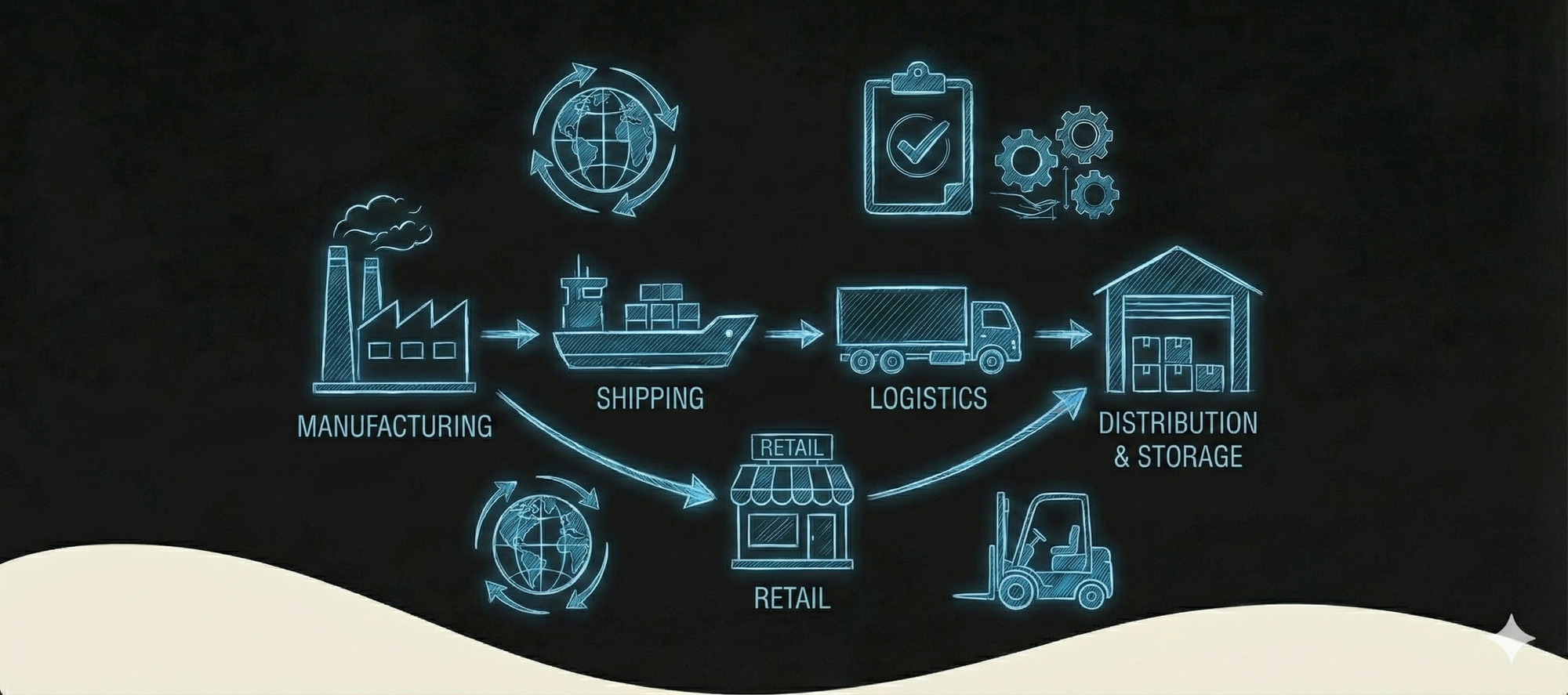
Introduction: The Deceptive Simplicity of A-to-B
Here is a simple problem: move a thing from Point A to Point B. That’s it. That’s logistics. A child with a toy car solves it a hundred times a day. Humanity has been solving it since we first decided one rock would look better over there, next to that other rock. It feels intuitive. It feels like something we should have mastered by now.
But it isn’t simple at all. Scale it up from one toy car to a fleet of 500 delivery vehicles, from one rock to fifty thousand daily orders, and the problem of A-to-B reveals its true nature. It is not a straight line. It is a universe of mathematical chaos, a swirling storm of constraints, variables, and possibilities that makes your head spin. How do you find the best path? How do you account for traffic, time windows, vehicle capacity, and the thousand other little things that can go wrong?
For a long time, we used maps, experience, and good old-fashioned guesswork. But now, we’re handing the problem over to Artificial Intelligence. And the answers AI is coming up with are forcing us to confront some deeply strange truths about how the world of physical things actually works. The solutions are getting weird.
The 'Perfect' Route is a Mathematical Ghost We Stopped Chasing Decades Ago
We all want the perfect route - the single, optimal path that saves the most time and fuel. It seems like a worthy goal for a powerful computer. The truth is, we gave up on finding it before most of today's programmers were even born.
The core of this challenge is called the Vehicle Routing Problem (VRP), first described back in 1959. It’s the classic puzzle of assigning orders to vehicles and then planning their routes. The problem is that the VRP is "NP-hard." In plain English, that means as you add more stops, the complexity of finding the one, single, absolute best solution doesn't just increase - it explodes exponentially. Calculating the perfect route for a city-wide delivery operation would take a supercomputer longer than the age of the universe.
AI didn't create this ghost, but it's the first tool powerful enough to make us stop pretending we could ever catch it. The scale and ambition of modern AI-driven logistics platforms force the entire industry to abandon perfectionism as a default strategy. So, what does the multi-billion dollar logistics industry do? It cheats. Instead of searching for the mathematically perfect route, the entire industry relies on heuristics - clever shortcuts and approximation algorithms - to find, in the words of researchers, "so-called good enough solutions in a reasonable time." We aren't seeking perfection; we're just trying to be reasonably, profitably, and quickly not terrible.
In a Dynamic World, Constantly 'Re-Optimizing' Can Be a Recipe for Going Nowhere
If you can't plan the perfect route in advance, why not just react perfectly in the moment? A new order comes in, a traffic jam appears - just re-run the numbers and immediately switch to the new, most optimal plan. It sounds smart. It sounds agile. In reality, it can be a recipe for total paralysis.
A paper on routing for robotic systems illustrated this with a beautifully maddening example. While this example comes from robotics, it's a stark warning for a future of AI-managed autonomous delivery fleets. Imagine a vehicle starting at a depot and heading toward its first stop. Suddenly, a new, high-priority request pops up back at the depot. The algorithm re-optimizes and correctly deduces that the most efficient thing to do right now is to turn around. But just as it gets close to the depot, another new request appears back at the original destination. Again, the algorithm re-optimizes and, again, the vehicle dutifully reverses course.
This continues, with the vehicle chasing the most logical immediate step, flipping back and forth in a frantic, pointless ballet. The stark conclusion from the research is that this constant, naive re-optimization can cause a vehicle to "travel forever without providing service to any demand." It is a perfect trap, a paradox where the relentless pursuit of moment-to-moment perfection leads to complete and utter system failure.
We're Solving 21st-Century Problems by Mimicking Ants and Evolution
Since finding the perfect route is impossible and reacting to new information can be a trap, how do we find those "good enough" solutions? We look to nature, which has been solving complex routing problems for millions of years. It turns out that some of the most effective AI in logistics today is inspired by the behavior of insects and the principles of natural selection.
As discussed in a case study on the topic, two of these "nature-inspired algorithms" are particularly popular:
- Ant Colony Optimization (ACO): This method is based on a simple observation. When ants search for food, they leave a trail of pheromones. Shorter paths get reinforced with more pheromones more quickly, which attracts more ants, who lay down more pheromones. Over time, this collective, decentralized process reveals the most efficient path. Logistics algorithms do the same, creating digital "pheromone" trails to help identify better routes from a swarm of possibilities.
- Genetic Algorithms (GA): This approach mimics evolution. A "population" of random routes is created. The "fittest" routes—those that are shorter or more efficient—are selected to "breed." They combine their characteristics ("crossover") and sometimes undergo random changes ("mutation") to create a new generation of routes. After many generations, only the strongest, most efficient routes survive.
There is a certain wry humor in the fact that the sophisticated systems directing fleets of diesel trucks are fundamentally based on the emergent intelligence of an ant looking for a breadcrumb or the genetic drift of a fruit fly.
The Supply Chain Is Becoming a Self-Healing Organism
For decades, the supply chain has been a thing we plan, execute, and then fix when it breaks. A storm hits, a factory closes, demand spikes - and humans scramble to reroute, reorder, and rebalance. But AI is pushing us toward a different model: a supply chain that anticipates and fixes problems on its own, like a biological organism healing a wound before it gets infected.
This is the concept behind the "Self-Healing Supply Chain." A prime example is Walmart’s Self-Healing Inventory system. This AI-driven platform doesn't wait for a store to report low stock. Instead, it constantly monitors inventory levels across the network, detects potential imbalances, and automatically redirects products to where they’ll be needed most - often before a problem would even be visible to a store manager.
This represents a profound shift toward autonomous management that "operates without human intervention." The goal is no longer just to react quickly, but to build systems that are inherently resilient. As one report notes:
These intelligent systems predict potential disruptions and automatically implement corrective actions, maintaining supply chain continuity and reducing the need for manual oversight.
The supply chain is evolving from a rigid, mechanical process into a responsive, adaptive, and predictive living system.
The Secret to Insane Speed is... Getting the Math a Little Bit Wrong on Purpose
In the world of optimization, speed is everything. A 10% faster calculation can save millions. A 100x speedup can change what's possible. But a 5,000x speedup? That requires breaking some fundamental rules. Specifically, it involves telling a computer to be less precise.
NVIDIA's cuOpt solver, for example, achieves "over 5,000x faster performance compared to CPU-based solvers" by running optimization algorithms on GPUs. A key part of this astronomical speedup comes from a technique related to approximate computing: using lower-precision numbers. Instead of using a standard 64-bit number for calculations, these systems can use 16-bit formats like bfloat16. This means the numbers are less exact - they carry fewer decimal places, so to speak - but they can be processed in vastly greater quantities.

A perfect analogy comes from image compression. Imagine an original, high-resolution photo of a beagle (top left). In the adaptive-precision version (bottom left), the image is almost indistinguishable from the original, yet only a fraction of the underlying data (12 of 191 columns, in this case) is stored in high-precision fp32, with the rest using the 'sloppier' bfloat16. But if you store the entire image in the low-precision bfloat16 format (bottom right), the quality degrades noticeably. The trick in logistics optimization is the same: get the math a little bit wrong in a controlled, intelligent way. In logistics, this is the equivalent of ensuring a delivery address's GPS coordinates are exact to the millimeter, while allowing the calculated distance of a single highway segment to have a tiny, inconsequential rounding error. You accept a tiny amount of mathematical "fuzziness" to gain an enormous advantage in computational speed, without sacrificing the accuracy needed for a useful real-world answer.
Conclusion: So It Goes
So there we are. To manage the simple act of moving things from A to B, we’ve arrived in a very strange place. We’ve accepted that the perfect solution is a dangerous fantasy. We’ve learned that trying to be perfect in every moment can lead to going nowhere at all. We build autonomous systems that mimic ants and heal themselves like organisms, and we achieve blinding speed by embracing a little bit of controlled sloppiness in our math.
The messy, chaotic, and beautiful truths of the physical world are being reflected in the AI we build to manage it. The machines aren't just calculating routes anymore; they are learning, adapting, and approximating in ways that feel unnervingly biological. As we build these systems to be not just fast, but imperfect, adaptive, and even a little bit sloppy, are we simply creating better tools, or are we giving birth to a new form of economic intelligence that will one day optimize for goals we don't yet understand?